

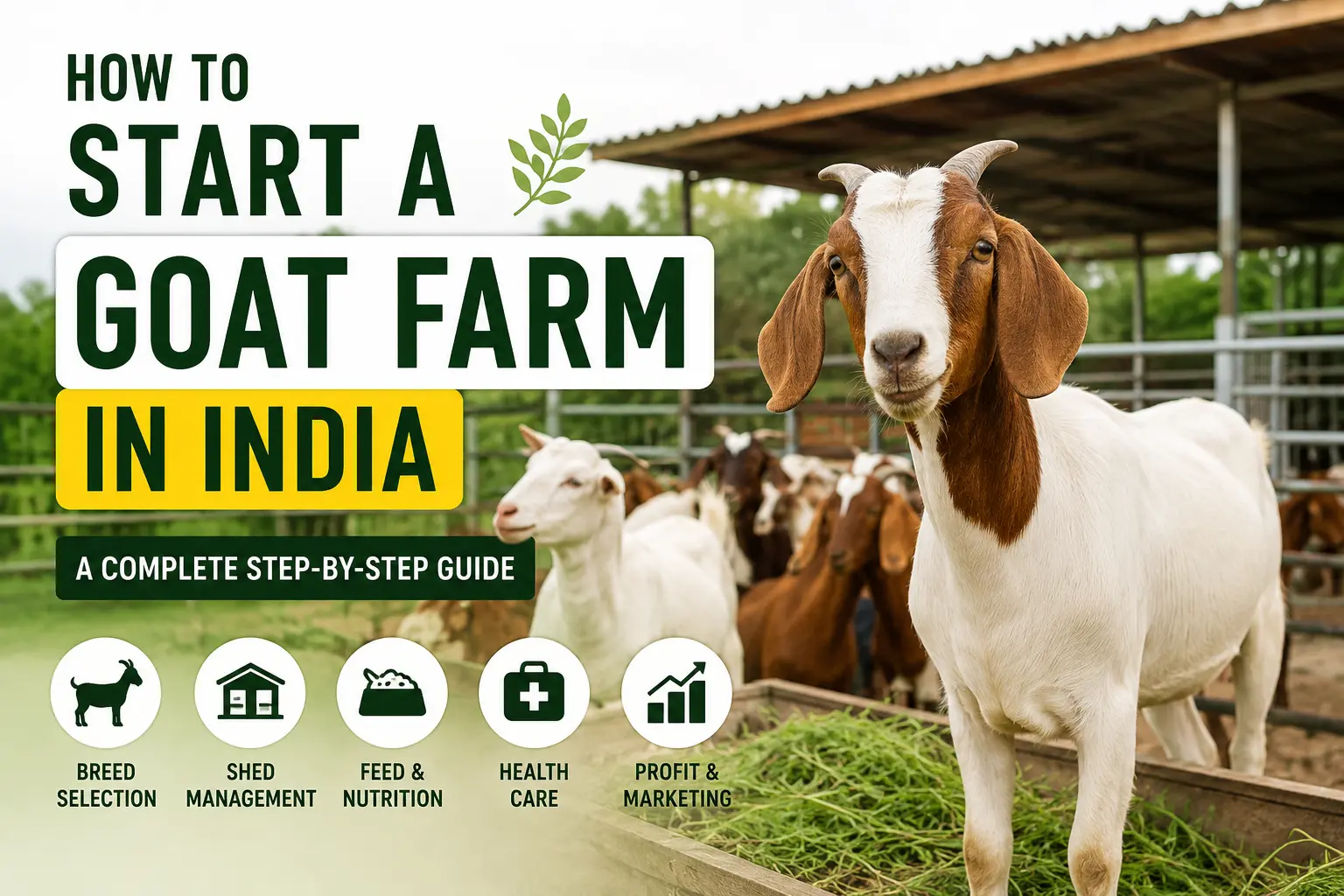
If you are serious about building a steady income from livestock, learning how to start goat farm in India is one of the smartest decisions you can make in 2026. Goat farming in India is not a new idea but what has changed dramatically in the last five years is the market. Meat prices have gone up by over 40% since 2019. Demand from urban markets, export processors, and the organised retail sector keeps growing every single year. A well managed farm with just 20 goats can generate a net profit of Rs 15,000 to Rs 25,000 per month. Scale that to 50 goats and you are looking at a serious primary income. I have worked closely with goat farmers across Rajasthan, Gujarat, and Maharashtra for years, and the ones who succeed all started with a clear plan and the right foundation. This guide on how to start goat farm in India gives you exactly that.
Is Goat Farming Profitable in India?
Before you spend a single rupee, you need to understand whether goat farming actually makes money and under what conditions it does and does not work.
The honest answer is yes, goat farming is profitable in India, but only when three things are in place at the same time. The right breed for your region and purpose, a proper feeding and health management system, and a clear plan for how you will sell your animals.
Here is a realistic monthly profit calculation for a 20 goat farm with 2 bucks:
A female Sirohi or Barbari goat kidding twice a year produces an average of 1.6 kids per kidding. On a 20 goat farm that means approximately 64 kids per year. At an average market weight of 20 kg per animal and a price of Rs 350 per kg live weight, each animal fetches around Rs 7,000. That gives you a gross income of approximately Rs 4,48,000 per year or Rs 37,000 per month from meat sales alone.
Your monthly costs on a 20 goat farm including feed, labour, medicines, and miscellaneous expenses come to approximately Rs 12,000 to Rs 15,000. Net profit sits between Rs 20,000 and Rs 25,000 per month when the farm is running well.
These numbers assume you are managing feed costs carefully, deworming regularly, and selling at the right time. Farmers who cut corners on nutrition and health management earn far less.
How Much Does It Cost to Start a Goat Farm in India?
This is the first question every beginner asks and the answer depends significantly on how many animals you start with and the quality of infrastructure you build.
Here is a realistic cost breakdown for three common farm sizes:
10 goat starter farm: Animals (8 does and 2 bucks at Rs 4,500 average): Rs 45,000 Basic shed construction: Rs 30,000 Feeders, waterers, and basic equipment: Rs 8,000 Feed for the first 3 months: Rs 12,000 Veterinary and vaccination costs: Rs 3,000 Total startup investment: approximately Rs 98,000
20 goat farm: Animals: Rs 90,000 Shed construction: Rs 55,000 Equipment: Rs 12,000 Feed for 3 months: Rs 22,000 Veterinary costs: Rs 5,000 Total startup investment: approximately Rs 1,84,000
50 goat commercial farm: Animals: Rs 2,25,000 Shed with proper ventilation and drainage: Rs 1,40,000 Equipment and storage: Rs 25,000 Feed for 3 months: Rs 55,000 Veterinary and insurance: Rs 15,000 Total startup investment: approximately Rs 4,60,000
These are conservative estimates based on current prices in Rajasthan and Gujarat. Land cost is not included because most farmers starting out use their existing land. If you are buying land separately, that changes the calculation entirely.
One mistake I see beginners make consistently is underestimating working capital. You need at least 3 months of operating expenses in reserve because your first batch of kids will not be ready to sell for 6 to 8 months. Many farms fail not because the model is wrong but because the farmer ran out of cash before the first sale.
Which Goat Breed Is Best for Farming in India?
Breed selection is one of the most important decisions you will make when you start goat farm in India because it determines your income potential, your feed costs, and how well your animals adapt to your local climate.
Here is a practical comparison of the top breeds for Indian farmers:
Sirohi is the most popular meat breed in Rajasthan and Gujarat. It is hardy, heat tolerant, and adapts well to dry and semi arid conditions. Average daily weight gain is 80 to 100 grams with good management. It is my top recommendation for farmers in western India starting out because it is locally available, easy to manage, and buyers know the breed well.
Barbari is a dual purpose breed from Uttar Pradesh and Rajasthan. It is smaller in size but highly prolific, often giving birth to twins and triplets. Excellent for farmers with limited land and feed resources because it is efficient with feed and matures faster than most other breeds.
Beetal from Punjab and Haryana is one of the best performing breeds for both meat and milk. It grows faster than Sirohi with an average daily gain of 100 to 120 grams under good feeding. Slightly more demanding in terms of nutrition and management but worth it if you can meet those requirements.
Jamunapari is India’s tallest goat breed and a strong milk producer. A good Jamunapari doe can give 2 to 3 litres of milk per day. Best for farmers targeting the milk market in UP, MP, and Rajasthan.
Osmanabadi from Maharashtra is well suited to the Deccan Plateau climate. Good meat yield and reasonable prolificacy. The preferred choice for farmers in Maharashtra and parts of Karnataka.
Black Bengal from West Bengal and eastern India has a smaller body size but exceptional meat quality and very high prolificacy. Extremely low input requirement makes it ideal for small and marginal farmers in eastern India.
My general advice is always the same. Buy the breed that is locally common in your district. A locally adapted breed will outperform an exotic breed brought from 500 km away every single time.
How Much Land Do You Need When You Start Goat Farm in India?
This is good news for farmers with limited land. Goats are among the most space efficient livestock you can raise anywhere in India.
For a stall fed system where animals are kept in the shed and feed is brought to them, you need approximately 1.5 square metres of floor space per adult goat and 0.75 square metres per kid. A 20 goat farm therefore needs a shed of approximately 40 to 45 square metres, which is a structure roughly 7 metres by 6 metres.
For a semi intensive system with a small grazing area attached, add approximately 5 square metres of paddock space per animal. The grazing reduces your feed costs by 20 to 30% and keeps animals healthier through natural exercise and foraging behaviour.
Even farmers in peri urban areas with half an acre of land can run a productive 20 to 30 goat operation using a stall fed system with purchased fodder.
How to Build a Goat Shed When You Start Goat Farm in India
A good shed does not need to be expensive. It needs to be dry, well ventilated, easy to clean, and designed to prevent the buildup of ammonia and moisture that cause respiratory disease.
The most practical design for Indian conditions is a raised slatted floor shed. The floor is built 1 to 1.5 metres above ground level using wooden slats or bamboo with 2 cm gaps between them. Droppings fall through to the ground below where they can be collected as manure. This keeps the living area dry and dramatically reduces foot rot, worm reinfection, and respiratory problems.
The roof should have a ridge vent for hot air to escape. The sides should be open or covered with wire mesh rather than solid walls to allow cross ventilation. In very cold regions like Himachal Pradesh or high altitude areas of Rajasthan, the sides can be covered with gunny bags or tarpaulin during winter months.
A basic raised floor shed for 20 goats costs approximately Rs 45,000 to Rs 55,000 using locally available materials. A more permanent cement and brick structure with a raised slatted floor costs Rs 80,000 to Rs 1,00,000.
Always separate your shed into sections. One area for pregnant does in the last month before kidding, one for kids under 3 months, and the main area for the rest of the herd. This separation prevents disease transmission and allows you to manage nutrition more precisely for each group.
What Do Goats Eat? A Complete Feeding Guide for Beginners
Feeding is where most beginner goat farmers either overspend unnecessarily or underfeed and wonder why their animals are not growing.
A productive goat needs four things in its daily diet. Green fodder for protein and vitamins, dry roughage for rumen fill and fibre, concentrate for energy and additional protein, and a mineral vitamin supplement to fill the gaps that fodder and grain alone cannot cover.
For an adult goat weighing 25 to 30 kg, the daily requirement is approximately 1.5 to 2 kg of green fodder, 0.5 kg of dry roughage like wheat straw or dry grass, and 150 to 200 grams of concentrate. For animals in the fattening phase targeting fast weight gain, increase concentrate to 300 to 400 grams per day and add 100 grams of mustard cake or groundnut cake for additional protein.
The mineral and vitamin component is where most Indian goat diets fall short. Standard green fodder and concentrate diets are consistently deficient in zinc, selenium, iodine, Vitamin A, and Vitamin D3. These deficiencies do not kill goats quickly but they silently suppress growth, reduce fertility, weaken immunity, and cut into your profit month after month.
VF2 Sheep and Goat is formulated specifically to address these gaps as per the latest NRC recommendations for small ruminants. It contains organic trace minerals in bioavailable forms, rumen modulators, and the complete vitamin profile that goats need for optimal growth, reproduction, and immunity. Add it to feed at 0.5 to 1 gram per kg of body weight daily and you will see the difference in growth rates and coat quality within 3 to 4 weeks. It is also one of the best goat weight gainer supplement in the Indian market.
Clean fresh water available at all times is non negotiable. A goat that does not drink enough will eat less, grow slower, and produce less milk. This sounds obvious but I have visited farms where water was available only twice a day and the farmer could not understand why his animals were underperforming.
What Is the 90% Subsidy for Goat Farming?
Yes, there are genuine government subsidies available for those who want to start goat farm in India and some of them are very substantial. Let me break down the real ones so you are not misled by outdated or exaggerated information circulating online.
Anyone who wants to start goat farm in India should know about the NABARD backed Dairy Entrepreneurship Development Scheme which covers small ruminants including goats and sheep. Under this scheme, the government provides a back ended capital subsidy of 25% of the project cost for general category farmers and 33.33% for SC and ST farmers. The maximum subsidy for a small ruminant unit is Rs 2.45 lakh for general farmers and Rs 3.27 lakh for SC and ST farmers.
Several state governments run their own additional schemes on top of NABARD funding. Rajasthan’s Kamdhenu Yojana, Gujarat’s Mukhyamantri Pashudhan Vikas Yojana, and UP’s Gopal Ratna Scheme all provide varying levels of subsidy for goat farm setup. In some states under specific schemes targeting tribal areas or drought prone regions, the combined central and state subsidy can reach 50% to 75% of project cost.
The 90% subsidy figure you sometimes see online typically refers to specific state level schemes for BPL families or SC and ST farmers in particular districts. These schemes exist but they are limited in budget and competitive in application. Do not base your entire business plan on receiving 90% subsidy. Plan for the standard 25 to 33% and treat anything beyond that as a welcome bonus.
To find the current subsidy schemes applicable to your district and category, visit your nearest District Animal Husbandry office or the NABARD district development manager office. Taking a printed project report with you significantly improves your chances of getting the application processed quickly.
Can I Get a Loan for Goat Farming?
Yes, and it is easier than most farmers realise. Goat farming is recognised as an agricultural allied activity which means it qualifies for priority sector lending from all nationalised and cooperative banks in India.
The most straightforward route is the Kisan Credit Card. If you already have agricultural land in your name, you can get a KCC with a limit of Rs 1.6 lakh without any collateral. Many banks allow KCC holders to use this limit for livestock purchase including goats. Interest rates are as low as 4% per annum after government interest subvention.
For larger loans above Rs 1.6 lakh, you can apply for a term loan under the Animal Husbandry Infrastructure Development Fund. You will need a project report, land documents, quotations for shed construction and animal purchase, and a bank account with 6 months of transaction history. Most nationalised banks process these in 4 to 6 weeks.
The process works best when you approach your bank with a proper project report. A one page financial projection showing the number of animals, expected kidding rate, sale price, costs, and repayment timeline makes a significant difference to how quickly and seriously the bank processes your application. I have seen farmers get loans approved in 2 weeks with a proper report and others wait 6 months without one.
MUDRA loans under the Kishore and Tarun categories ranging from Rs 50,000 to Rs 10 lakh are also available for goat farming as a micro enterprise. These are available through commercial banks, small finance banks, and microfinance institutions across India.
Common Diseases to Know Before You Start Goat Farm in India
Disease is the single biggest risk to profitability on a goat farm, especially in the first year when your animals are adjusting to a new environment and your management systems are still developing.
The most important diseases to know and prevent are PPR (Peste des Petits Ruminants), FMD (Foot and Mouth Disease), enterotoxaemia, and internal parasites.
PPR is the most devastating goat disease in India. It spreads rapidly through a flock and mortality can reach 80 to 90% in an unvaccinated herd. The PPR vaccine costs approximately Rs 3 to Rs 5 per animal and provides 3 years of protection. There is absolutely no excuse for an unvaccinated herd. Get every animal vaccinated within the first 2 weeks of purchase.
FMD vaccination should be done every 6 months. Enterotoxaemia vaccination should be done annually. Deworming with albendazole or ivermectin every 90 days is essential for maintaining growth performance. A goat carrying a heavy worm burden will not gain weight no matter how well you feed it.
Strong immunity starts with nutrition. Animals deficient in Vitamin E, selenium, and zinc have significantly weaker immune responses and are far more susceptible to all of the above diseases. This is the nutritional reason why daily mineral vitamin supplementation is not optional on a productive goat farm.
How to Earn Money from Goat Farming?
There are four main revenue streams available to a goat farmer in India and the most successful farms use more than one of them at the same time.
Meat sales are the primary income source for most goat farms. You can sell live animals directly to butchers, at local livestock markets (mandi), or to meat processing companies if you are near an urban centre. Eid ul Adha (Bakrid) is the single highest demand period of the year with prices rising 40 to 70% above regular rates. Planning your kidding schedule so that animals reach 20 to 25 kg by Bakrid is one of the most reliable ways to maximise your annual income.
Breeding stock sales often generate higher per animal income than meat sales. A well bred Sirohi or Beetal buck in good condition sells for Rs 15,000 to Rs 25,000 or more. If you build a reputation for quality animals in your area, farmers will come to you for breeding stock and you can command premium prices consistently.
Milk sales from breeds like Jamunapari or Beetal can add Rs 4,000 to Rs 8,000 per month on a 20 goat farm if you are milking 8 to 10 productive does. Even farms primarily targeting meat can sell milk from lactating does before weaning the kids at 2 months.
Manure sales are the most underestimated income stream in goat farming. Goat manure is among the best organic fertilisers available and farmers in your area will pay for it. A 20 goat farm can produce 400 to 500 kg of dry manure per month. At Rs 3 to Rs 5 per kg that is an additional Rs 1,500 to Rs 2,500 per month in income from something most farmers simply give away or discard.
What Is the Best Time to Sell Goats?
Timing your goat sales correctly can increase your annual income by 30 to 50% without changing anything else about your farm operations.
Eid ul Adha (Bakrid) is by far the most important sale window of the year. Demand for goats spikes dramatically in the 2 to 3 weeks before the festival and prices rise by 40 to 70% above regular market rates. Plan your breeding calendar so that your animals are 8 to 10 months old and at a good market weight of 20 to 25 kg during this window. Missing Bakrid by even 2 weeks means selling at standard prices which significantly impacts your annual profit.
The second best sale window is Dussehra and Navratri when meat consumption increases significantly across many communities. This is particularly relevant for farmers in Rajasthan, MP, and UP.
Outside of festival windows, Monday and Thursday are traditionally the highest demand days at most livestock mandis across India. Animals sold on these days consistently fetch Rs 20 to Rs 50 per kg more than animals sold midweek.
Avoid selling in July and August if you can. Monsoon season depresses livestock prices because transport is difficult, buyers are busy with farming, and overall demand is lower. If your animals are ready during this window, hold them for 6 to 8 more weeks and target the festival season instead.
Step by Step Action Plan to Start Your Goat Farm in India
Many people research how to start goat farm in India for months but never take the first step because the process feels overwhelming. This action plan breaks it down month by month so you always know exactly what to do next.
Month 1: Planning and paperwork. Finalise your breed choice based on your region. Visit 2 to 3 existing goat farms in your area and speak to farmers honestly about their challenges and income. Prepare your project report. Apply for your loan or arrange your own capital.
Month 2: Infrastructure. Build your shed before buying animals. Never buy animals first and then scramble to arrange housing. Prepare your fodder growing area if you have land available. Arrange reliable green fodder suppliers for the months when your own fodder is not ready.
Month 3: Animal purchase. Buy animals from a reputable breeder in your district. Get animals vaccinated for PPR and FMD before or immediately after purchase. Quarantine new animals for 14 days before mixing them with any existing stock. Begin feeding VF2 Sheep and Goat daily from day one.
Month 4 to 6: Establish management routines. Stick to a fixed feeding schedule every day. Deworm all animals at the 90 day mark. Record each animal’s weight every month using the heart girth measurement method. Observe closely for any signs of disease and act immediately rather than waiting.
Month 7 onward: First sales. Your first batch of kids should be approaching market weight. Time your sales around the festival calendar for maximum returns. Reinvest a portion of income into expanding your herd steadily.
Frequently Asked Questions
How many goats do I need to make a profit? A minimum of 10 does with 1 to 2 bucks is needed to generate meaningful income. Most experienced farmers recommend starting with 20 does because the economics improve significantly at this scale and the cost per animal for management and marketing is lower.
How long before a goat farm becomes profitable? The first thing to know when you start goat farm in India is that most farms break even by month 8 to 10 and start generating consistent net profit from month 12 onward. The first year is always the hardest because you are building the herd, learning management, and establishing your sales channels.
What is the mortality rate in goat farming? On a well managed farm with proper vaccination, deworming, and nutrition, annual mortality should be below 5%. Farms with poor management see 15 to 25% mortality which completely destroys profitability. Good nutrition and timely vaccination are far cheaper than the animals you lose without them.
Can I do goat farming part time while working a job? Yes. Up to a herd of 20 to 25 goats can be managed part time with 2 to 3 hours of daily work if you have one family member assisting. Beyond 25 goats, dedicated full time attention becomes essential for the farm to perform well.
Which is more profitable, goat farming or poultry farming? Goat farming requires higher upfront investment but offers lower risk, longer productive life per animal, multiple income streams, and significantly better resilience to disease outbreaks. Poultry gives faster returns but is more vulnerable to disease and market price fluctuations. Most experienced farmers prefer goats for stable long term income.
Is there insurance available for goats? Yes. The National Livestock Mission and many state governments offer livestock insurance for goats at a subsidised premium of 4 to 5% of the animal’s value per year. Always insure your breeding stock. The premium is small compared to the financial loss of a high value buck or a productive doe.
Related Reading:
I like that you emphasize profitability depends on more than just buying goats—the focus on breed selection, feeding, and having a clear sales plan is something many beginners overlook. It would also be helpful to include a simple example of how local fodder costs affect monthly profits, since feed expenses can vary a lot from region to region.