

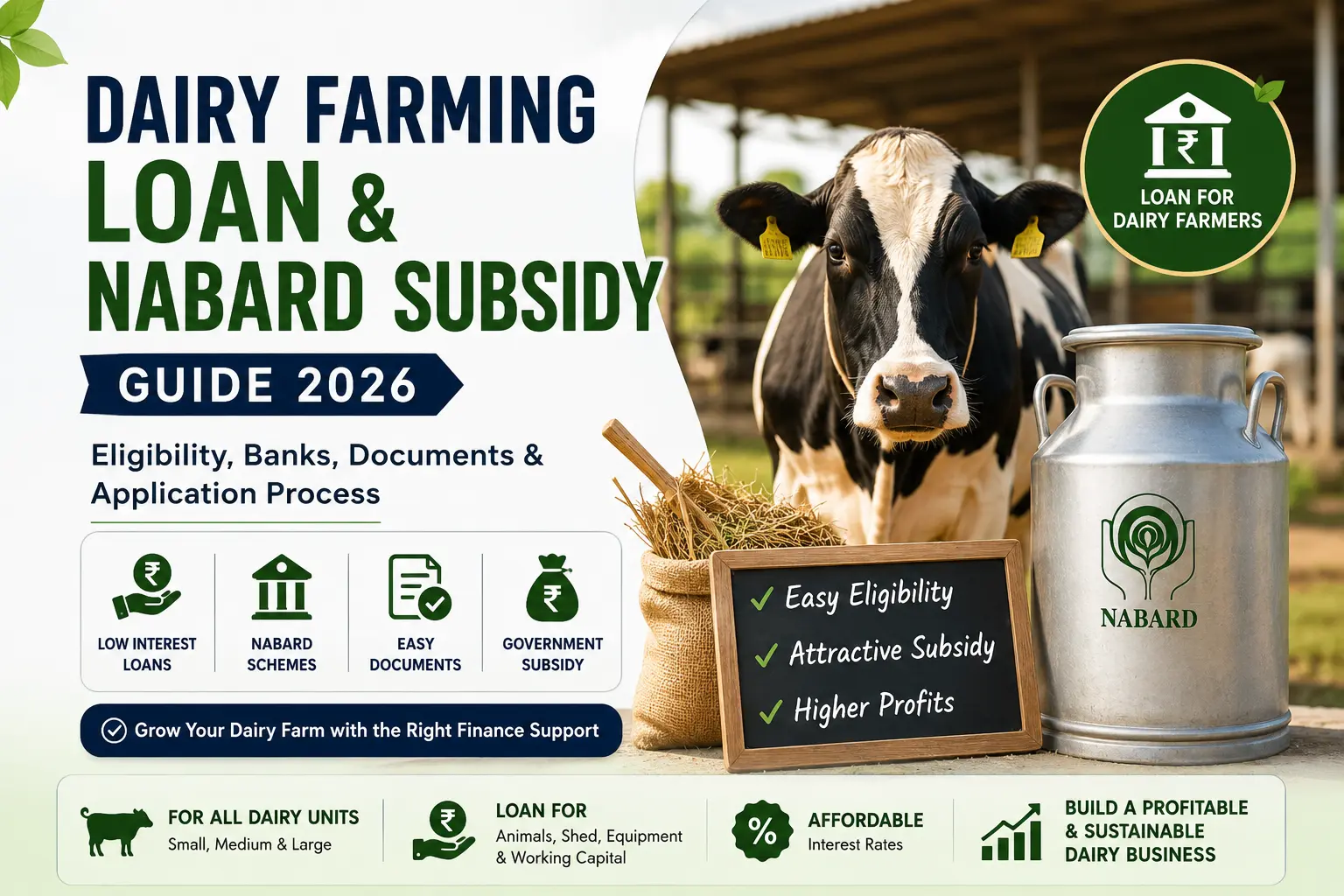
Starting a dairy farm requires more than good cattle and quality feed. Whether you plan to start a 10-cow dairy farm or expand an existing unit, access to affordable finance can make a huge difference.
Many farmers search for NABARD dairy loans, government subsidies, and dairy farming bank loans, but there is often confusion about how these schemes actually work.
This guide explains the latest information on dairy farming loans, NABARD-linked schemes, subsidy opportunities, eligibility requirements, and the banks that finance dairy projects in 2026.
What Is the NABARD Dairy Loan Scheme 2026?
One of the biggest misconceptions among farmers is that NABARD directly gives loans for dairy farming.
In reality, NABARD (National Bank for Agriculture and Rural Development) does not usually provide loans directly to individual dairy farmers. Instead, NABARD supports banks by refinancing agricultural and rural loans. Farmers generally apply through commercial banks, regional rural banks (RRBs), cooperative banks, and other approved financial institutions.
If you want funding for:
Purchasing cows or buffaloes
Building cattle sheds
Installing milking machines
Fodder cultivation
Dairy farm expansion
you normally apply through a participating bank, not directly through NABARD.
Is NABARD Subsidy Available for Dairy Farming?
Yes, subsidy-linked opportunities still exist for eligible dairy projects, but farmers should understand that schemes change over time.
Historically, dairy projects received support under NABARD-linked subsidy programs such as the Dairy Entrepreneurship Development Scheme (DEDS). However, many banks now guide applicants toward newer livestock and dairy infrastructure schemes, including the Animal Husbandry Infrastructure Development Fund (AHIDF) and other state-specific programs.
Before applying, always verify the current subsidy status with your nearest bank branch, district animal husbandry office, or NABARD district office because subsidy guidelines can vary by state and project type.
Can a Dairy Farmer Get a Loan from NABARD?
A dairy farmer can receive a NABARD-supported loan, but not directly from NABARD in most cases.
The process typically works like this:
Prepare a dairy farm project report.
Approach a participating bank.
The bank evaluates the project.
The loan is sanctioned by the bank.
NABARD may support the lending institution through refinance mechanisms.
This means farmers should focus on preparing a strong project report and choosing the right lending institution.
Which Bank Gives a Loan for Dairy Farming?
Several banks in India finance dairy farming projects.
Common options include:
State Bank of India (SBI)
Punjab National Bank (PNB)
Bank of Baroda
Canara Bank
Union Bank of India
Regional Rural Banks (RRBs)
District Cooperative Banks
Cooperative Agriculture and Rural Development Banks
The best bank is often the one that actively finances agricultural projects in your district and has experience evaluating dairy farm proposals.
How Much Loan Can You Get for Dairy Farming?
The loan amount depends on:
Number of animals
Breed quality
Shed construction cost
Equipment requirements
Working capital needs
Project viability
Small dairy units may require a few lakh rupees, while commercial dairy farms can receive substantially larger financing depending on repayment capacity and project economics.
What Documents Are Required for a Dairy Farm Loan?
Most banks commonly ask for:
Aadhaar Card
PAN Card
Address proof
Passport-size photographs
Land ownership or lease documents
Bank statements
Dairy farm project report
Quotations for equipment
Income proof (if applicable)
Additional documents may be required depending on the bank and loan amount.
How to Apply for a Dairy Farming Loan?
Step 1: Create a Dairy Farm Business Plan
Your project report should include:
Number of cows or buffaloes
Expected milk production
Feed and fodder costs
Veterinary expenses
Revenue projections
Loan repayment plan
Step 2: Visit a Bank
Approach banks that actively finance agricultural and animal husbandry projects.
Step 3: Submit Documents
Provide KYC documents, project report, and supporting records.
Step 4: Site Verification
The bank may inspect your land or proposed dairy unit.
Step 5: Loan Approval and Disbursement
Once approved, funds are released according to the project requirements.
Is Dairy Farming a Good Business in 2026?
India remains the world’s largest milk producer, and demand for milk and dairy products continues to grow.
However, profitability depends on:
Breed selection
Animal health
Feed quality
Reproduction management
Milk yield
Local milk prices
Many dairy farms struggle not because of low milk prices, but because of poor nutrition management and low productivity per animal.
Also read : Dairy Farming Business Guide 2026
What Is the Biggest Reason Dairy Farms Fail?
The most common reasons include:
Poor feeding practices
Mineral deficiencies
Reproductive problems
High disease incidence
Lack of financial planning
Purchasing low-quality animals
A profitable dairy farm focuses on both finance and animal nutrition.
How Can Farmers Improve Milk Production After Taking a Dairy Loan?
Taking a loan is only the first step.
To maximize returns:
Feed a balanced ration
Use quality mineral supplements
Maintain proper breeding schedules
- Using milk booster for dairy cows
Monitor body condition scores
Reduce heat stress
Follow vaccination and deworming schedules
Even a small increase in milk production per cow can significantly improve loan repayment capacity over time.
Is a Dairy Farm Loan Worth It?
A dairy farm loan can be a valuable investment if:
You have proper training
You understand dairy economics
You prepare a realistic project report
You maintain good animal health
You focus on milk productivity
Borrowing without a clear business plan can create repayment pressure, while a well-managed dairy farm can generate stable long-term income.
Frequently Asked Questions (FAQs)
Can I get a dairy farm loan without agricultural land?
Some banks may finance dairy projects on leased land or rented facilities, subject to their lending policies and project viability.
What is the ideal size for a beginner dairy farm?
Many experts recommend starting with 5–10 animals before expanding.
Can women apply for dairy farm loans?
Yes. Women entrepreneurs, self-help groups, and farmer producer organizations may be eligible for various livestock financing programs.
Is collateral required for dairy farm loans?
It depends on the loan amount, scheme, bank policy, and applicant profile.
Does NABARD provide money directly to farmers?
Generally, no. NABARD primarily supports lending institutions rather than directly financing individual dairy farmers.
Final Thoughts
Dairy farming remains one of India’s most promising rural businesses, but success depends on much more than obtaining a loan. The most profitable dairy farms combine smart financing, healthy cattle, proper nutrition, and strong management practices.
Before applying for any dairy farm loan or subsidy, compare bank options, prepare a detailed project report, and ensure your farm has a clear path to sustainable milk production and profitability.